May 23, 2010 at 10:50 am | Uncategorized
- Posted by Jennifer |
The 2010 Vernacular Architecture Forum conference, “Housing Washington,” has sadly drawn to a close. I’ve heard from many in the architectural history and preservation fields that VAF conferences are their favorite, and now I understand why. A great balance of bus tours, walking tours, and sessions of three 20-minute presentations grouped by theme keeps things moving and interesting.
As for me, I somehow managed to get through my presentation, “Postwar Prefabs in the Washington, D.C., Suburbs: The Mass-Production Success of Vernacular Prefab Homes,” without dry heaves or hyperventilating. Many thanks to session moderator Janet Foster, of Columbia University, and the other session presenters, Nancy Holst and Erin Cunningham, for providing a supportive, collegiate atmosphere.
I was pleasantly surprised at the interest the audience showed in my topic — more historians have begun to take interest in the prefab homes in their own postwar suburbs. Read the rest of this entry »
September 12, 2009 at 7:50 pm | 20th century, Uncategorized, metal, modernism, prefab
- Posted by Jennifer |
Aluminaire, NYIT, Central Islip, NY, Aug. 2009
The 1931 Aluminaire just can’t catch a break. It has been moved, and subsequently forgotten, not once, not twice, but thrice in its lifetime. Each time, after a brief flurry of excitement about this one-of-a-kind early American International-style house, it has faded back into obscurity, waiting to be rediscovered yet again.
Designed by architects A. Lawrence Kocher and Albert Frey for the 1931 Architectural League exhibition in New York, the Aluminaire was one of only two houses by American architects to be included in the Museum of Modern Art’s famed 1932 International Exhibition of Modern Architecture.
In the late 1980s, a grassroots campaign helped save the house from demolition, and the New York Institute of Technology got a grant to disassemble and move the house to their Central Islip, Long Island campus. Here’s a New York Times piece about the restoration project.
Read the rest of this entry »
July 29, 2009 at 1:45 pm | Uncategorized
- Posted by Jennifer |

Bell Labs, Holmdel, NJ / by Flickr user sodapop / CC BY-ND 2.0
With the increase in preservation of 20th-century historic sites has come a parallel rise in preservation efforts for buildings and places that played host to some of the greatest innovations in science & technology. As a former digital content manager, married to a computer programmer who’s nuts about science, I’ve been following with interest the efforts to preserve Nikola Tesla’s 1902 Lab on Long Island and the Eero Saarinen-designed Bell Labs in New Jersey, the site of significant research leading to the computer and cellphone.
Now tech history buffs have a new guidebook, The Geek Atlas. A BBC News story, “Follow in the footsteps of geeks,” features this new travel guide that highlights important science & tech history sites across the globe. Although heavy on places in the UK, the guide includes sites such as the White Sands missile testing range in New Mexico and the Jacquard Museum in Roubaix, France, with exhibits on punched-card weaving technology, predecessor to the modern computer. Each entry in the book includes background info and precise GPS coordinates, natch.
BBC journalist Bill Thompson says, “It’s our geek heritage, and the more we make people aware of it the more likely it is to be preserved in some way.”
Read the full BBC article >
May 5, 2009 at 4:15 pm | Uncategorized
- Posted by Jennifer |
The BBC is currently airing a documentary series on English Heritage, a historic preservation (termed “conservation” in the UK) governmental advisory commission. It’s a rare opportunity to get an inside look at how our British brethren face the day-to-day challenges of preservation, including the ongoing debate about brutalism. Unfortunely, the Guardian claims that this “grimly funny series,” also called “English Heritage,” reinforces stereotypes about elitist preservationists. You can decide for yourself by watching the show online. Currently the show is only viewable online by those within the UK, but English Heritage has established a webpage to cast light on the issues raised in the program.
The very nature of preservation often has us on the defense, fighting to be heard by developers, city councils, and sometimes the public at large. But we run the risk of taking ourselves too seriously. A TV series exposing the process of preservation, warts and all, can still raise the profile of the overall issue of the importance of place and preserving our built heritage, pushing the dialogue forward. And that’s a good thing.
May 3, 2009 at 11:49 pm | Uncategorized
- Posted by Jennifer |
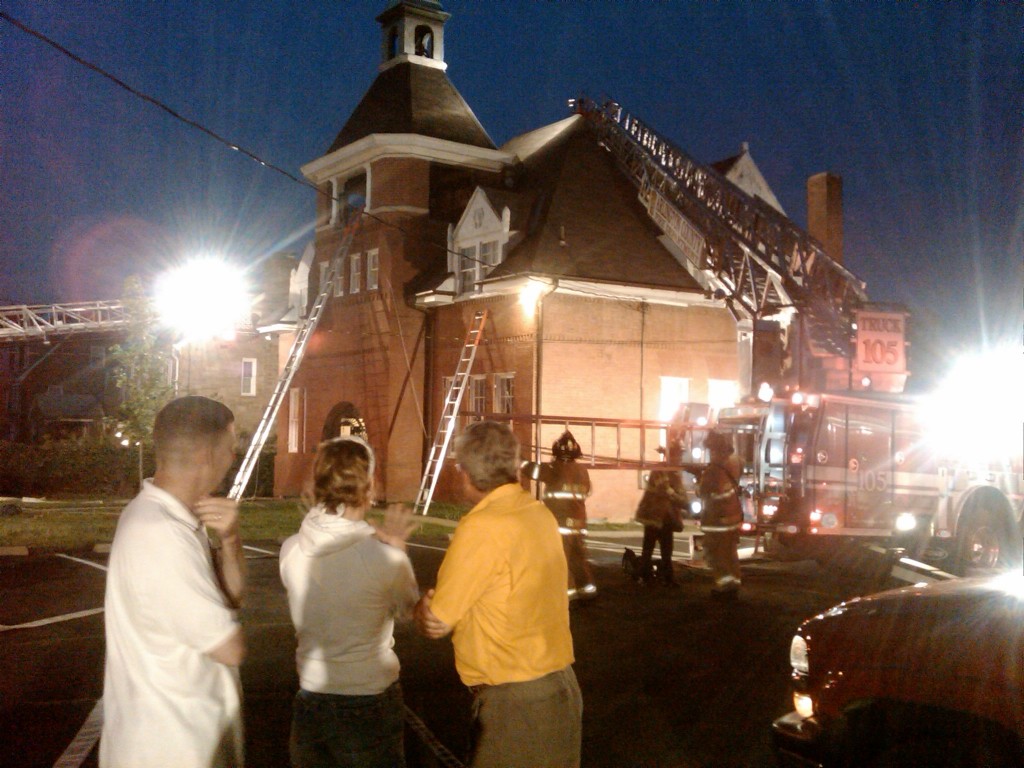
One week ago, on Sunday night around 8:00pm, I received an emergency call that made my heart stop — an ADT rep told me that the smoke detectors in the Arlington Historical Museum had just been set off, and they had notified the fire department. It was the type of call I’d feared most as Chair of the Museum Building Committee. Our museum and extensive local artifact collection is housed in the historic 1891 Hume School building, by noted Washington architect B. Stanley Simmons.
When I arrived at the museum about 15 minutes later, this was the horrifying scene I encountered, sure to make any museum director’s or board of directors’ blood run cold.

Read the rest of this entry »
April 21, 2009 at 1:05 pm | Uncategorized
- Posted by Jennifer |
The Humanities Council of Washington, DC is offering up to $2,000 for nonprofits working on projects to document and preserve DC’s heritage. Deadline for applications is May 1st. To get information and assistance for applying, attend the grant workshop tonight, Tuesday, April 21 rom 5:30 PM to 7:00 PM, at the Southeast Neighborhood Library.
For more information, contact Albert Shaheen at grants@wdchumanities.org or check the Humanities Council of Washington, DC website.